
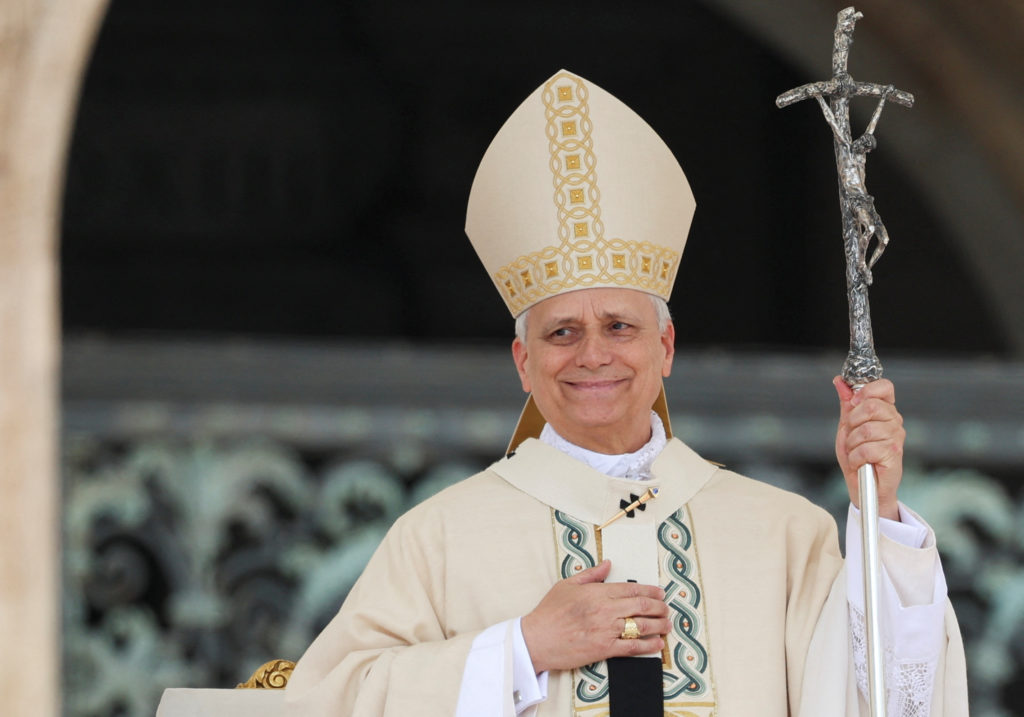
Pope Leo XIV gestures at the end of his inaugural Mass in Saint Peter’s Square, at the Vatican May 18, 2025. REUTERS/CLAUDIA GRECO
Long before modern nation-states, secular governments, or corporate research centers existed, the Catholic Church gave birth to the university system—a legacy that continues to shape education, science, technology, and culture across the world today.
What we now take for granted as “higher education” was not invented by kings or philosophers acting alone, but by the Church’s conviction that faith and reason belong together.
Church’s Vision: Faith That Thinks
From the earliest centuries, the Catholic Church believed that loving God included loving truth.
As St. Augustine famously taught, “All truth is God’s truth.”
The Church therefore encouraged the systematic study of theology, philosophy, medicine, law, mathematics, astronomy, and the natural sciences—not to replace faith, but to deepen it.
This vision culminated in the medieval university, a uniquely Catholic institution that combined:
*Academic freedom
*Structured degrees
*Faculty guilds
*A universal curriculum
*Moral and spiritual formation
The word ‘universitas’ itself originally referred to a community of scholars, not buildings—teachers and students united in the pursuit of truth under the protection of the Church.
Clergy Who Initiated The University Movement
The university system did not arise spontaneously. It was initiated, protected, and staffed by clergy, including:
*Cathedral bishops who established cathedral schools
*Monastic orders (Benedictines, Dominicans, Franciscans) who preserved classical learning
*Pope Innocent III – patron of scholars and universities
*St. Albert the Great (Dominican friar) – pioneer in natural sciences
*St. Thomas Aquinas (Dominican priest) – whose synthesis of faith and reason became foundational to university education
Many early professors were priests or religious, and theology was considered the “queen of the sciences.”
The Oldest Universities In Europe (All Catholic Foundations)
1. University of Bologna (1088) – Italy
Oldest continuously operating university in the world
*Specialized in canon law and civil law
*Operated under papal protection
*Educated clergy, jurists, and civil administrators
2. University of Paris (c. 1150) – France
Emerged from Notre Dame Cathedral School
*Center of theology and philosophy
*Home to St. Thomas Aquinas
*Operated under direct Church authority
3. University of Oxford (c. 1096) – England
*Developed from monastic and cathedral schools
*Deeply Catholic before the Reformation
4. University of Cambridge (1209) – England
*Founded by Catholic scholars fleeing Oxford disputes
*Entirely Catholic for centuries
These universities shaped Western civilization, law, science, and governance—all under the umbrella of the Church.
The Oldest University In Asia
University of Santo Tomas (1611) – Philippines
*Founded by Dominican friars
*Oldest existing university in Asia
*Pontifical and Catholic university
Played a key role in:
*Medicine
*Law
*Engineering
*Theology
*Filipino nation-building
UST stands as living proof that the Church did not merely evangelize Asia—it educated it.
The Oldest Catholic Universities In The America’s
United States
Georgetown University (1789)
*Founded by Jesuit priest Fr. John Carroll, the first Catholic bishop in the U.S.
*Emphasized classical education, ethics, and public service
*Continues the Jesuit mission of forming “men and women for others”
Latin America
National University of San Marcos (1551) – Peru
*Founded by Dominican friars
*Oldest university in the Americas
*Chartered by the Spanish Crown and approved by the Pope
*Educated clergy, doctors, lawyers, and administrators for the New World
Other early Catholic universities include:
*University of Mexico (1551)
*University of Santo Tomás de Aquino (1538, Dominican)
Why The Church Built Universities
The Church never feared knowledge. On the contrary, she built institutions to protect it.
The goals were clear:
*To form intellectually competent and morally grounded individuals
*To advance science, medicine, agriculture, engineering, and law
*To improve livelihood, governance, and technology
*To ensure that progress served human dignity, not destruction
This is why:
*Clergy pioneered astronomy, genetics, and medicine
*Monasteries developed agriculture and engineering
*Universities became engines of innovation
Modern research ethics, peer review, degrees, and academic freedom all trace back to Catholic roots.
Faith and Reason: Not Enemies But Partners
The Catholic Church’s creation of the university system stands as a historical refutation of the myth that Christianity opposed learning.
Instead, the Church built the very framework that made modern education possible.
As St. John Paul II wrote in Fides et Ratio:
“Faith and reason are like two wings on which the human spirit rises to the contemplation of truth.”
The university system is one of the Church’s greatest gifts to humanity—a reminder that to be faithful is not to be ignorant, and that to seek God is also to seek wisdom.