
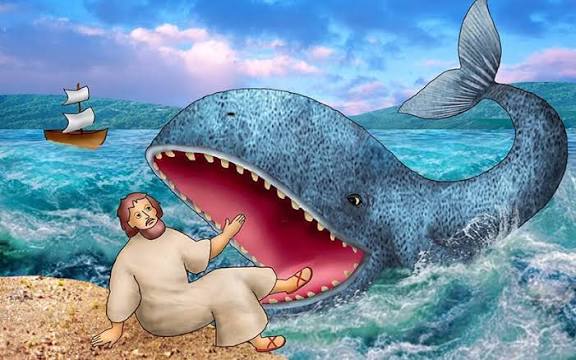
Since we have already established in part one that a fish swallowing a human being is impossible, it follows that when approaching the Jonah story, there are only three options available. Everyone is free to choose any one of them.
The first option is to discard the story completely as nonsense, or dismiss it as a fairy tale with nothing to offer. There is no attempt to understand it, no willingness to read beyond the surface. The conclusion is already settled: “This story is stupid.”
The second option is to hold a literal interpretation and insist, without evidence, that somehow, somehow, a fish swallowed Jonah and comfortably housed him for three days and three nights, rent free.
Because, of course, “there is nothing the Lord cannot do.”
Or as Francis D. Arinze commented under part one of the post:
“I’ll be waiting for part two before concluding on this post. But before part two comes out, I want to ask whether the God who parted the Red Sea cannot prepare a fish to swallow a man even with a small throat? Can we ask for the place of the miraculous in this matter? Or is the parting of the Red Sea and all miraculous testimonies of the scriptures false?”
And truly, if you cannot explain the existence of a single fly, or how the universe came into being, or even your own existence, then if a Being is behind all that, what exactly is fish swallowing Jonah that He cannot do?
The third way is the most demanding.
This approach insists that before we discard the story like those in the first option, or accept it uncritically like those in the second, we should at least give the text the benefit of the doubt. We must look at it carefully, critically, and through the eyes of the author. And maybe, just maybe, after that process, we may then have good reason either to discard it or to believe it.
This option requires that we return to the text and ask honest questions.
What were the writers trying to communicate? Were the words meant literally or symbolically? Is the fish descriptive rather than biological? Is there internal logic to the story?
Now let us be honest.
The easiest option is the first: discard the story. But the problem with that approach is that it throws the story away before allowing it to speak for itself. It is intellectual laziness. It is the atheist shortcut.
If you belong to the second group, your case is simple. Faith settles it. No questions required. It is almost the opposite of the first view. But such faith is not cheap, and not everyone can carry it honestly.
But if you choose the third path, then you are in uncomfortable territory. You are standing between disbelief and blind belief. This path demands patience, humility, and deep respect for the text.
So tell me, where do you belong?
I would like to know before I proceed.
#PurestPurity