
By Fr. Kelvin Ugwu, MSP
If you belong to the third group, as I highlighted in part two of this series, then this is the first place to begin your enquiry.
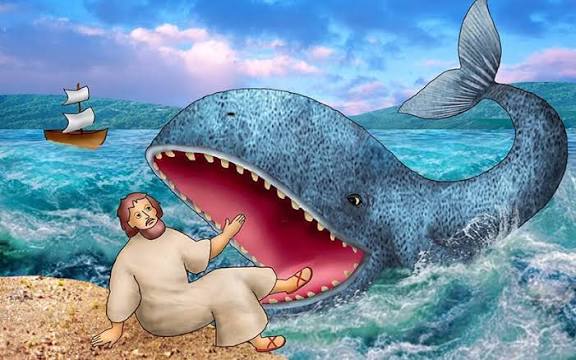
The question to ask is this: which fish swallowed Jonah? This question is important because it takes you straight back to the text itself, not to what you were taught by your Sunday school teacher who may have been exaggerating things so you could grasp the story as a child.
The original Hebrew passage appears in Jonah 1:17, which is Jonah 2:1 in the Hebrew numbering. It says:
וַיְמַן יְהוָה דָּג גָּדוֹל לִבְלֹעַ אֶת־יוֹנָה וַיְהִי יוֹנָה בִּמְעֵי הַדָּג שְׁלֹשָׁה יָמִים וּשְׁלֹשָׁה לֵילוֹת׃
Transliteration:
“Wayeman YHWH dag gadol livlo’a et-Yonah; wayehi Yonah bime’ei hadag sheloshah yamim usheloshah leilot.”
You do not need to know Hebrew. All I need you to pay attention to are the words “DAG GADOL.” You will see them immediately after YHWH.
Dag Gadol (דָּג גָּדוֹל) means a great or huge fish.
This is why different translations rendered it this way:
————
New International Version says HUGE FISH
“Now the LORD provided a huge fish to swallow Jonah, and Jonah was in the BELLY of the fish three days and three nights.”
Good News Translation says LARGE FISH
“At the LORD’s command a large fish swallowed Jonah, and he was INSIDE the fish for three days and three nights.”
God’s Word Translation says BIG FISH
“The LORD sent a big fish to swallow Jonah. Jonah was INSIDE the fish for three days and three nights.”
International Standard Version says LARGE SEA CREATURE
“Now the LORD had prepared a large sea creature to swallow Jonah, and Jonah was INSIDE the sea creature for three days and three nights.”
English Revised Version says GREAT FISH
“And the LORD prepared a great fish to swallow up Jonah; and Jonah was in the BELLY of the fish three days and three nights.”
————
So you see, the name of the fish was never given, only a description of its size. Any fish you imagine in your head, whether shark, catfish, or whale, is not what the Bible said. That is your addition, not the text.
Do not add what is not there. Allow the passage to reveal itself.
Now pay close attention to the second line of that same verse in Jonah 1:17 (2:1):
“Jonah was in the BELLY OF THE FISH for three days and three nights.”
The next question is unavoidable: what does it mean to be in the BELLY OF THE FISH?
Take note that the Bible did not say Jonah was in the stomach of the fish. It says he was in the belly of the fish. This may sound like a minor detail until you realise that the difference matters.
The stomach is a specific internal organ associated with digestion. The word translated as belly comes from the Hebrew me‘eh (מֵעֶה), which refers more broadly to the inner parts, the inward cavity, or the internal region, not explicitly the digestive stomach itself.
If the writers meant stomach in the strict sense, Hebrew had a word for it. Qebah (קֵבָה) is the Hebrew word for stomach, and it was not used here.
Remember, the aim is to read the text as it stands, without forcing our assumptions into it.
Why does this matter?
Because when a fish swallows prey, it goes directly into the stomach and digestion begins immediately. But Jonah is never said to be in the stomach. He is said to be in the belly.
What is the text trying to communicate?
Read Jonah chapter two.
In that chapter, Jonah prays in the belly of the fish. Three different times, Jonah refers to where he is, and yet he never describes the place as a fish.
He says:
“Out of the belly of Sheol I cried”
“The deep surrounded me”
“The earth with its bars closed upon me forever”
Notice what is missing.
No mention of a fish’s anatomy
No mention of air or survival tactics
No struggle against digestion
The fish disappears from the prayer and is replaced by the word Sheol.
Why?
The answer is simple. The fish is a vehicle, not the message. The real location is Sheol, the realm of death.
The “belly of the fish” functions as symbolic language for descent into death, chaos, exile, and Sheol.
Jonah prays like a dead man, not like a trapped survivor.
This begins to make sense when Jesus later uses the Jonah analogy to describe what would happen to him for “three days and three nights” after his crucifixion.
The obvious fact staring us in the face is that the story was never really about a physical fish. In fact, no physical fish swallowed Jonah. The story is deeper than that.
How do I know?
I will tell you in the next part.
This part is already too long.
#PurestPurity