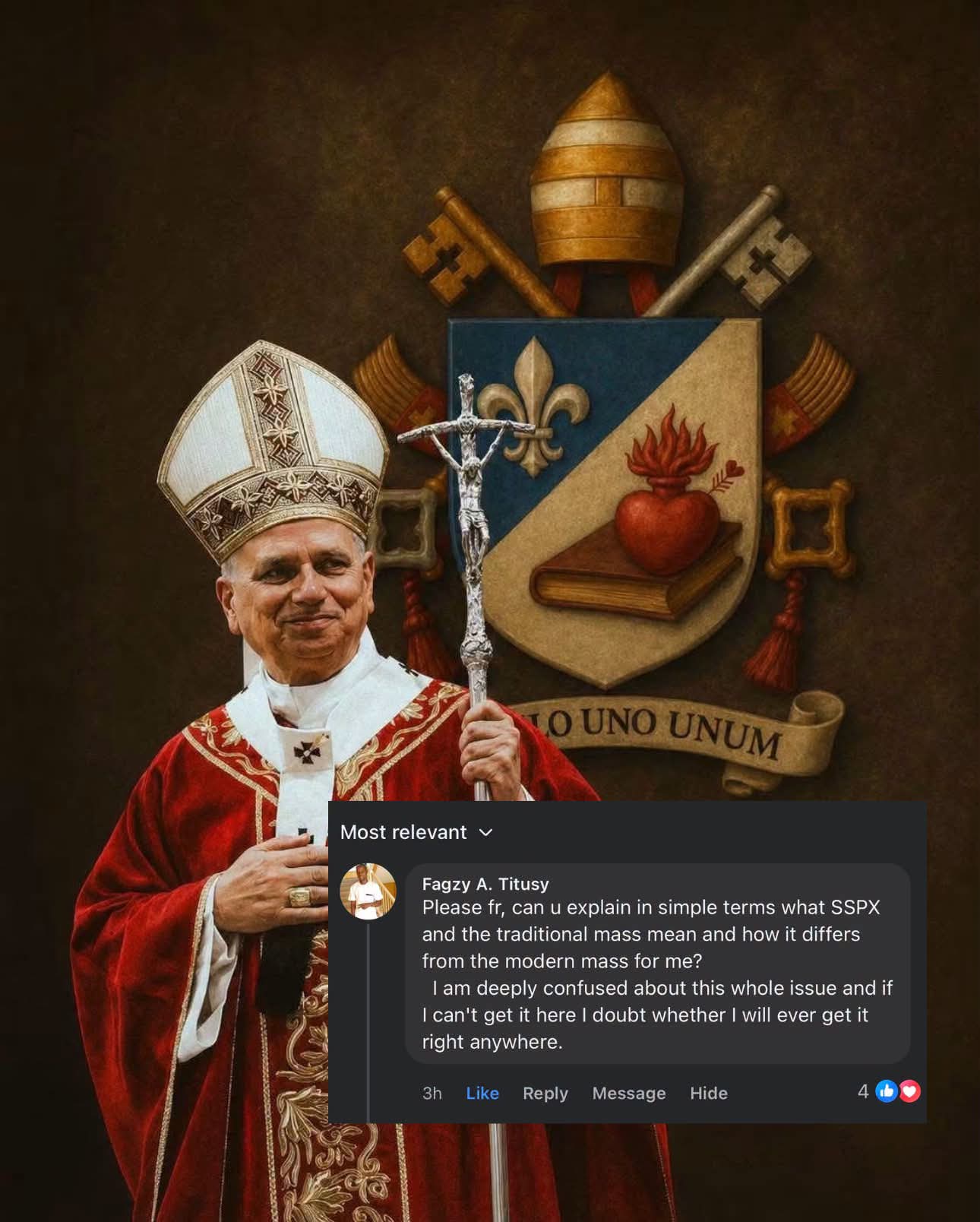
Let me try to explain the SSPX issue with the Vatican in the simplest way I can. You can save and share this post and read it at your convenience.
- The root of the issue lies in the teachings and reforms of the Second Vatican Council.
- For those who may not know what the Second Vatican Council was: on January 25, 1959, Pope John XXIII announced his intention to convene a council of the world’s Catholic bishops to discuss important issues facing the Church. The overall aim was to renew the Church and help it engage more effectively with the modern world. Since this council was held in the Vatican and was the second ecumenical council to be held there, it became known as the Second Vatican Council, or Vatican II.
- The Second Vatican Council officially began on October 11, 1962, and concluded on December 8, 1965.
- Although Pope John XXIII convened the Council, he did not live to see it conclude. After his death, Pope Paul VI continued and completed it.
- Unlike some earlier councils, Vatican II did not define any new dogmas. Rather, it presented the Catholic faith in a way that would better engage the modern world. Among its reforms were permitting wider use of local languages in the Mass instead of only Latin, encouraging the fuller participation of the laity in the liturgy, promoting dialogue with other Christian denominations, and improving relations with Jews and followers of other religions.
- Many Catholics welcomed these reforms, while others believed the Church had gone too far. This is where SSPX comes into the story.
- Before discussing SSPX, we must first talk about Archbishop Marcel Lefebvre, the founder of the Society and the central figure in this entire controversy. He was a French Catholic archbishop, missionary, and former Superior General of the Holy Ghost Fathers (Spiritans). Before Vatican II, he was widely respected in the Church for his missionary work in Africa and for his strong defense of Catholic orthodoxy.
- Archbishop Marcel Lefebvre attended the Second Vatican Council and even signed its documents. However, he later became convinced that some interpretations and applications of the Council were harmful to the Church.
- Those who were not alive before Vatican II may not fully appreciate how different Catholic worship was at the time. Practices that are common today, such as clapping, dancing, or other forms of expressive participation at Mass, would have shocked many Catholics before Vatican II. The Mass was celebrated almost entirely in Latin, including the readings and prayers.
- To be fair to Archbishop Lefebvre, he sincerely believed that after Vatican II, Catholic doctrine was being watered down, seminaries were declining, priests were abandoning traditional teachings, reverence in the liturgy was disappearing, and Catholic identity was becoming weaker. He blamed much of this on the way Vatican II was being interpreted and implemented.
- In 1970, Archbishop Lefebvre founded the Society of Saint Pius X (this is where the SSPX comes from).
- The purpose of the Society was to train priests, preserve the traditional Latin Mass, preserve traditional Catholic theology, and resist what Lefebvre considered dangerous innovations in the Church.
- It is important to note that the Society was initially approved by the Church. At that stage, there was no schism and no major conflict.
- The problems began when Archbishop Lefebvre openly criticized certain post-Vatican II developments, including the new form of celebrating the Mass, aspects of ecumenism, and the Council’s teaching on religious liberty. He believed the Church was abandoning Tradition.
- At that point, the Vatican concluded that his actions and teachings were undermining the unity of the Church. In 1975, the Holy See withdrew SSPX’s canonical approval.
- Archbishop Lefebvre did not stop. He continued ordaining priests, opening seminaries, and carrying on the Society’s activities. The dispute gradually shifted from theological disagreements to questions of obedience and Church authority.
- His argument was that if Church leaders had departed from Tradition, Catholics had a duty to preserve Tradition even if that meant resisting those leaders.
- By 1988, Archbishop Lefebvre was growing old and feared that SSPX would disappear after his death. He wanted bishops who could ordain priests, confirm Catholics, and continue the Society’s work. During this period, Rome was negotiating with him. On May 5, 1988, Lefebvre and the future Pope Benedict XVI (then Cardinal Joseph Ratzinger) even signed an agreement outlining a path toward reconciliation. The following day, however, Lefebvre withdrew from the agreement, saying he no longer trusted Rome’s promises.
- On June 30, 1988, Archbishop Lefebvre consecrated four bishops without papal approval, arguing that he was acting out of necessity to preserve the Catholic faith. According to canon law, this act incurred automatic excommunication, a penalty later declared by the Vatican.
- In 2009, Pope Benedict XVI lifted the excommunications of the four bishops as a gesture of reconciliation. However, SSPX itself remained without regular canonical status, and the doctrinal disagreements between the Society and the Vatican remained unresolved.
- Today, only two of the four bishops consecrated in 1988 are still alive, and both are elderly. (Bernard Fellay was 30 when he was ordained bishop, today he is 68 and Alfonso de Galarreta who was 31 when he was ordained bishop, today he is 69)
- SSPX feared that without new bishops it would not be able to continue its apostolate. Therefore, just as it did in 1988, it has now consecrated four more bishops in 2026 without papal approval, despite direct warnings from the Vatican. The Vatican responded by declaring the newly consecrated bishops excommunicated.
- That is the story in its simplest form. This is just a simplified historical summary, not an attempt to settle the theological debate. Thank you for reading. If you found it helpful, feel free to save and share it.
Fr Kelvin Ugwu